
MASS GENERAL'S CENTER FOR PELVIC FLOOR DISORDERS
'A Game Changer for Our Patients'
Women with complex pelvic-floor conditions now can receive care at a unique clinical center — Mass General’s Center for Pelvic Floor Disorders — where a team of pelvic-health specialists work together to optimize each patient’s treatment.
One-Stop Shopping for Complex Pelvic Disorders
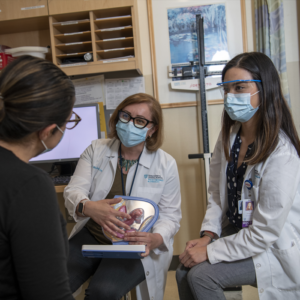
“Patients seen at the Center for Pelvic Floor Disorders are not routine cases,” said Vi Duong, MD (in photo at right), a Vincent fellow in Female Pelvic Medicine and Reconstructive Surgery (FPMRS). Instead, they may have complex conditions involving various regions of the pelvic floor — the muscles, ligaments and tissues in the lower abdominal area. “It’s the first-year fellow’s responsibility to compile these patients’ medical records, then in monthly virtual meetings, present the cases to a multidisciplinary team at Mass General Hospital. Together, they customize a treatment plan for each patient.”
One-third of all women eventually experience a pelvic-floor disorder, a number increasing with an aging population. Among many contributing factors are trauma related to vaginal childbirth, heavy lifting, repetitive straining (constipation), obesity, degenerative neurologic conditions, traumatic injury and cancer therapy. “Complex cases, however, often require multiple specialists,” said Milena Weinstein, MD (in photo at left), the Vincent’s FPMRS fellowship director, who cofounded and now co-directs the Center with Liliana Bordeianou, MD, chief of colorectal surgery. Over the past 10 years, the service has grown into an official Mass General Hospital Center with a database of more than 8,000 patients. “Our unique approach is designed to offer one-stop shopping.”
Patients sometimes had surgeries elsewhere, which did not work. Or they may be seeking a second opinion. Conditions needing repair may include vaginal, uterine or rectal protrusion (pelvic organ or rectal prolapse) such as prolapse of the anterior vaginal wall (cystocele), posterior vaginal wall (rectocele) or vaginal apex (enterocele). Some disorders also may involve malfunction of pelvic organs, such as urinary or fecal incontinence, constipation, sexual dysfunction or a resection syndrome that occurs after rectal cancer surgery. “When patients try to piece together a treatment plan with multiple specialists, that process often can take months,” said Marcus Ortega, MD, who serves on the Vincent’s FPMRS faculty after completing training in 2021 in the Vincent’s fellowship program, a funding priority of the Vincent Memorial Hospital Foundation. “It’s best if all pelvic-health specialists work together from the start, then schedule procedures in a way convenient for the patient.”
“Whenever possible, the surgical team performs their specialty procedure in the same operation,” Dr. Duong said, with pre- and post-operative care often involving specially trained physical therapists. “Getting all their care in one place is a game-changer for our patients.”