
VINCENT FELLOWS IN GYNECOLOGIC ONCOLOGY
Pursuing Women’s Cancers
Each year, approximately 95,000 women in the United States are diagnosed with gynecologic cancer including the five main types — ovarian, cervical, uterine, vaginal and vulvar cancer. Unfortunately, more than 30,000 will die. With support from The Vincent Memorial Hospital Foundation, Vincent fellows in Gynecologic Oncology are seeking new ways to improve outcomes and save lives.
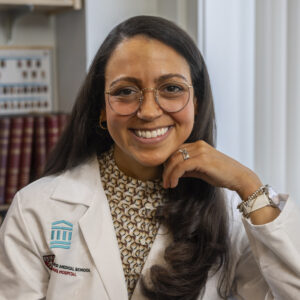
Does Sentinel Lymph Node Biopsy in Early-Stage Cervical Cancer Perform as Well in Real-World Practice as in Prospective Studies?
Alex Rosenthal Powers, MD, ScM, a Vincent fellow in Gynecologic Oncology, is analyzing data from the National Cancer Database (NCDB), a national cancer registry capturing more than 70% of incident cancers in the United States, to better understand patterns of care, treatment effectiveness, and survival outcomes in gynecologic oncology. Her current research portfolio spans multiple projects at various stages of development. One study compares the real-world performance of sentinel lymph node biopsy to lymphadenectomy in light of emerging evidence suggesting that sentinel lymph node biopsy improves detection of positive lymph nodes in this patient population. Another project updates survival data using a difference-in-differences framework to evaluate long-term outcomes among patients treated in hospitals with high versus low adoption of neoadjuvant chemotherapy for ovarian cancer. She continues to work with Dr. Melamed to develop additional studies, including an analysis of surgical versus fertility-preserving management of cervical and uterine rhabdomyosarcomas, with a focus on how outcomes vary by age. In addition to her work with the NCDB, Dr. Powers is conducting a retrospective case-control study using Mass General Brigham data to examine how evolving, molecularly informed treatment paradigms in endometrial cancer may influence recurrence patterns.
Faculty Mentor
Alexander Melamed, MD, MPH, Clinician Investigator and Associate Professor of Obstetrics, Gynecology and Reproductive Biology, Division of Gynecologic Oncology
Career Path
MD/ScM: Warren Alpert Medical School, Brown University, 2017–2021
OB/GYN Residency: Beth Israel Deaconess Medical Center, 2021–2025
Vincent Fellowship: 2025–2028
Publications
- Comparative analysis of adjuvant treatment outcomes in stage III endometrial cancer: overall survival, recurrence-free survival, site of primary recurrence, and toxicity
- Financial toxicity in BRCA1 and BRCA2 carriers
- Timing of trial of void after radical hysterectomy: Long-term urinary outcomes at two academic tertiary care institutions
- The past and future of gender nondiscrimination policy under the affordable care act
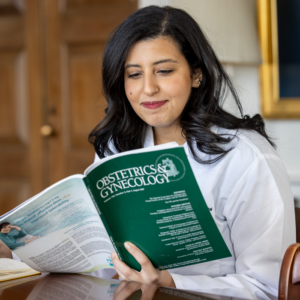
Do All Patients with Advanced Cervical Cancer Have the Same Access to Novel Treatment Strategies?
Alicia M. Youssef, MD, a Vincent fellow in Gynecologic Oncology, is also a research fellow at the Continuum Project. As a Vincent fellow, she is critically examining data from national clinical databases to identify healthcare disparities among patients with advanced gynecologic malignancies. She is using the National Cancer Database, a national cancer registry containing more than 70,000 ovarian cancer cases, to identify trends in the access and administration of immunotherapy to patients with advanced cervical cancer. Through the Continuum Project, Dr. Youssef is researching ways to improve the timeliness, quality and documentation of serious illness conversations among patients with gynecologic cancers. This research involves using natural language-processing technology to better characterize serious illness conversations in the electronic health record. Additionally, she is working to better understand the perceptions and experiences of bereaved caretakers of patients with gynecologic cancer to identify ways in which end-of-life care can be improved.
Faculty Mentors
Alexander Melamed, MD, MPH, Clinician Investigator and Associate Professor of Obstetrics, Gynecology and Reproductive Biology, Division of Gynecologic Oncology
Joanna Paladino, MD, Physician–Investigator in the Center for Aging and Serious Illness at Mass General, Associate Director of Research at the Mass General Continuum Project, Assistant Professor of Medicine at Harvard Medical School
Career Path
MD: University of Minnesota Medical School–Twin Cities, 2016–2020
OB/GYN Residency: Women and Infants Hospital of Rhode Island, Brown University, 2020–2024
Vincent Fellowship: 2024–2027
Publications
- Comparing the predictive value of the surprise question across training levels for estimating twelve-month mortality in gynecologic oncology patients in the outpatient setting
- Supporting families facing lactation anaphylaxis: a case report
- Timing of trial of void after radical hysterectomy: long-term urinary outcomes at two academic tertiary care institutions
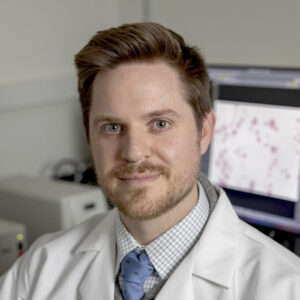
What Are the Mechanisms of Resistance to ‘Antibody Drug Conjugate Therapy' in Ovarian Cancer?
William Manning, MD, is a Vincent fellow in Gynecologic Oncology currently investigating the mechanisms of resistance to antibody drug conjugate (ADC) therapy in ovarian cancer. This therapy combines an antibody to a specific tumor-associated target with a cytotoxic payload that is taken up by the tumor cells upon binding. While effective for some ovarian cancers, there is evidence for resistance mechanisms that allow the cancer to progress and evade ADC therapy. Dr. Manning is investigating these resistance mechanisms by creating models of cancer cell lines from patients whose cancers developed resistance to the therapy. His research involves growing and assessing organoids, which are three-dimensional cultures derived from tumor cells that replicate much of the cellular complexity of the primary tumor. This research will help determine the optimal sequencing of ADC therapy and elicit mechanisms of resistance that may be targetable to enhance or extend the benefits of therapy.
Faculty Mentor
Oladapo Yeku, MD, PhD, Director of Translational Research, Gynecologic Oncology Program
Career Path
MD: University of Texas Health Science Center at San Antonio, 2015-2019
OB/GYN Residency: Women and Infants Hospital of Rhode Island, Brown University, 2019–2023
Vincent Fellowship: Gynecologic Oncology, Vincent Department of OB/GYN, Mass General, 2023–2026