
Vincent Center for Reproductive Biology
Postdoctoral Research Fellows
Postdoctoral fellows make key contributions to research in the Vincent Center for Reproductive Biology (VCRB). These young scientists, who have completed their doctoral studies, advance women’s health by working with VCRB investigators to discover new pathways to treat and prevent diseases. Below are select profiles of past and present postdoctoral fellows, whose work has been invaluable to VCRB investigators in the pursuit of novel areas of inquiry.
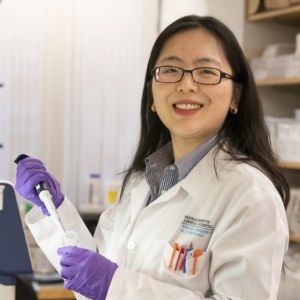
Immune-based Target Therapies for Ovarian Cancer
Mengyao Xu, PhD, a postdoctoral research fellow in the laboratory of Oladapo Yeku, MD, PhD, FACP, received her PhD in 2022 in oncology from the Nankai University School of Medicine in China, where during her doctoral studies she focused on the identification of highly metastatic human ovarian cancer genes via CRISPR-Cas9 screenings. Her current research program in the VCRB aims to develop new immune-based target therapies against ovarian cancer. She is working on validating the targeting effect by using MUC16-based ADC, BiTEs, CAR-T alone or in combination with other immunomodulatory agents in vitro and in vivo and evaluating their mechanisms of action in ovarian cancer.
Faculty Mentor
Oladapo Yeku, MD, PhD, FACP, Associate Scientist, VCRB
Career Path
PhD: Nankai University School of Medicine, China, 2022
Postdoctoral Research Fellowship: Vincent Center for Reproductive Biology, 2022–present
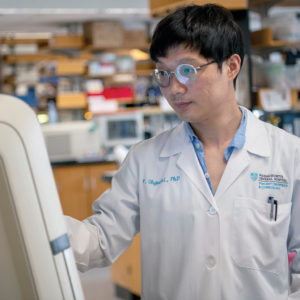
Microbes that Promote Ovarian Cancer
Peichao Chen, PhD, in the lab of Cheng Wang, PhD, is studying microbial infections ― particularly the bacterium Chlamydia trachomatis ― that promote high-grade serous ovarian cancer. Arising mostly from epithelia of the ovary and fallopian tube, this cancer comprises the majority of ovarian cancer cases and has the lowest survival rate. He is leading a new study examining how C. trachomatis transforms ovarian and fallopian tube epithelial cells, aiming to prevent this deadly disease or stop its progression in early stages.
Faculty Mentor
Cheng Wang, PhD, Investigator, Vincent Center for Reproductive Biology
Career Path
PhD: Hunan Normal University, Changsha, China, 2012
Assistant Researcher: Tongji University, Shanghai, China, 2012–2013
Assistant Professor: Wenzhou University, Wenzhou, China, 2013–2017
Associate Professor: Wenzhou University, Wenzhou, 2017–present
Postdoctoral Research Fellowship: Vincent Center for Reproductive Biology, 2019–present
Publications
- Proteomic landscape of liver tissue in old male mice that are long-term treated with polysaccharides from Sargassum fusiforme.
- Sargassum fusiforme Fucoidan SP2 extends the lifespan of Drosophila melanogaster by upregulating the Nrf2-mediated antioxidant signaling pathway.
- Sargassum fusiforme polysaccharides activate antioxidant defense by promoting Nrf2-dependent cytoprotection and ameliorate stress insult during aging.

Impact of Maternal Obesity on Offspring
Sezen Kislal, PhD, with Andrea Edlow, MD, is investigating how exposure to maternal obesity and a high-fat diet in utero can negatively affect the brain development of offspring in a sex-specific fashion and how this affects behavior. She is studying the placenta-brain connection, the relationship between maternal inflammation and the fetal innate immune response, and how the offspring’s sex can affect metabolic programming in maternal obesity, with the goal of finding ways to ameliorate deleterious changes.
Faculty Mentor
Andrea Edlow, MD, MSc, Investigator, Vincent Center for Reproductive Biology
Career Path
PhD: Pennsylvania State University, 2015
Postdoctoral Research Fellowship: Stanford University, 2015–2017
Postdoctoral Research Fellowship: Vincent Center for Reproductive Biology, 2019–present
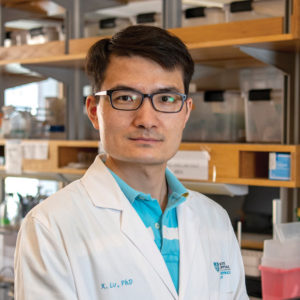
The Achilles Heel of Women’s Cancers
Xiangmin Lv, PhD, in the Wang Lab, is investigating key molecular pathways — particularly the Hippo/YAP signaling pathway — that initiate and promote the development of the most deadly type of ovarian cancer and the most prevalent uterine-cervical cancer. Combining cutting-edge molecular biology, cell and organoid culture, and animal models, he focuses not only on the tumor cell itself but also the interactions between cancer cells and immune cells, with the aim of finding novel targets to cure women’s gynecologic cancers.
Faculty Mentor
Cheng Wang, PhD, Investigator, Vincent Center for Reproductive Biology
Career Path
PhD: University of Nebraska Medical Center, 2017
Postdoctoral Research Fellowship: Vincent Center for Reproductive Biology, 2017–present
Publications
- Reprogramming of ovarian granulosa cells by YAP1 leads to development of high-grade cancer with mesenchymal lineage and serous features.
- A human papillomavirus-independent cervical cancer animal model reveals unconventional mechanisms of cervical carcinogenesis.
- Timely expression and activation of YAP1 in granulosa cells is essential for ovarian follicle development.
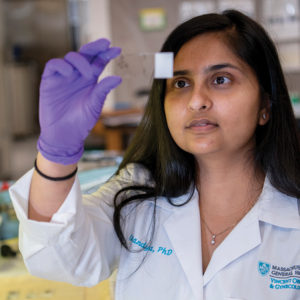
Checkpoints in Endometrial Cancer
Unnati Pandya, PhD, with Bo Rueda, PhD, is focusing on endometrial cancer, the most prevalent gynecologic cancer in the United States. She is investigating the ubiquitin proteasome system (UPS), which controls normal protein degradation including that of cell-cycle checkpoint proteins, to ensure regulated cell turnover. In the uterus, an imbalance of UPS proteins can lead to uncontrolled cell proliferation and cancer. She is testing the efficacy of novel small molecule inhibitors that disrupt specific actions of the UPS machinery, with the goal of developing new therapeutics.
Faculty Mentors
Bo Rueda, PhD, Director, Vincent Center for Reproductive Biology
Whitfield Growdon, MD, Investigator, Vincent Center for Reproductive Biology
Career Path
PhD: Cleveland State University, 2014
Postdoctoral Research Fellowship: New York University School of Medicine, 2014–2017
Postdoctoral Research Fellowship: Vincent Center for Reproductive Biology, 2017–present
Publications
- Ovarian cancer stem cells: What progress have we made?
- Hormonal and growth regulation of epithelial and stromal cells from the normal and malignant endometrium by pigment epithelium-derived factor.
- TGF-β activates APC through Cdh1 binding for Cks1 and Skp2 proteasomal destruction stabilizing p27Kip1 for normal endometrial growth.

Vaginal Microbiome Transplant
Laura Yockey, MD, PhD, in the lab of Caroline Mitchell, MD, is studying the vaginal microbiome, a community of organisms found in the vagina. She is focusing on bacterial vaginosis, a disorder involving disruptions in the microbiome associated with discomfort and poor reproductive outcomes. Available treatments have low success rates, resulting in high rates of recurrence. The lab recently initiated an FDA-approved trial for a novel treatment — a vaginal microbiome transplant — with the hope of developing an effective long-term solution.
Faculty Mentors
Caroline Mitchell, MD, MPH, Investigator, Vincent Center for Reproductive Biology
Andrea Edlow, PhD, Investigator, Vincent Center for Reproductive Biology
Career Path
MD/PhD: Immunobiology, Yale University, 2012–2019
Postdoctoral Research Fellowship: Vincent Center for Reproductive Biology, 2019–2020
Internal Medicine Residency, Massachusetts General Hospital, Stanbury Physician Scientist Pathway, 2020–2022