
VINCENT CENTER FOR REPRODUCTIVE BIOLOGY
Into the Clinic
In translational research, investigators work to find solutions in the lab, then translate these findings into novel treatments offered to patients in clinical studies. Results of these clinical trials are used to define future patient treatments. Below is a sampling of clinical studies emerging from findings initially made in the VCRB laboratory.

MGB OB/GYN
Vice Chair of Research,
Understanding Maternal Immunity
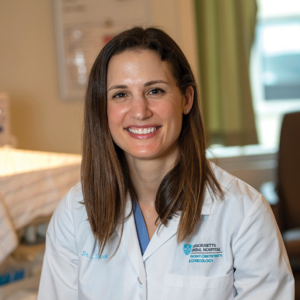
Andrea Edlow, MD, MSc, an OB/GYN subspecialist in Maternal-Fetal Medicine, has dedicated her career to understanding maternal immunity. A mother’s exposures in pregnancy impact not only the mother, but also the placenta and the developing fetus, with potential short- and longer-term consequences. The Edlow Lab works to understand how in utero exposures affect fetal brain development, impacting risk for childhood neurodevelopmental disorders such as autism spectrum disorder, attention deficit hyperactivity disorder or learning disabilities. The Edlow Lab also investigates maternal, placental and fetal immune responses to viruses and vaccines, and has assembled one of the largest biorepositories of maternal infection and vaccination in pregnancy in the country. Her lab was the first to study the impact of maternal obesity on the amniotic fluid transcriptome, generating important insights on the impact of maternal exposures on the developing fetal brain. Her lab also was the first to demonstrate that the initial SARS-CoV-2 variants were very unlikely to be vertically transmitted, i.e., directly transmitted from mother to embryo, fetus or baby during pregnancy or childbirth. Her lab also was the first to generate key data on the efficacy of COVID-19 vaccines in pregnancy, helping drive changing guidelines that encouraged pregnant women to be vaccinated during the COVID-19 pandemic.
In addition to being an Investigator in the Vincent Center for Reproductive Biology and working as a Maternal-Fetal Medicine physician at Mass General, Dr. Edlow serves as the Vice Chair of Research for Mass General Brigham’s merged Academic Medical Center, Department of Obstetrics and Gynecology. In this role, she seeks to ease the burdens of research for clinicians, researchers and patients to make the department’s research maximally impactful for advancing science and providing evidence-based patient care. A critical part of both her clinical and scientific work is providing training and mentorship to the next generation of physicians and scientists.
Publications
- Shook LL, Kislal S, Bordt EA, Devlin BA, Edlow AG. Hofbauer cells and fetal brain microglia share transcriptional profiles and responses to maternal diet-induced obesity. Cell Rep. 2024 Jun 25;43(6):114326. Epub 2024 Jun 8.
-
Shook LL, Batorsky RA, De Guzman RM, McCrea LT, Brigida SM, Horng JE, Sheridan SD, Kholod O, Cook AM, Li JZ, Goods BA, Perlis RH, Edlow AG. Maternal SARS-CoV-2 impacts fetal placental macrophage programs and placenta-derived microglial models of neurodevelopment. J Inflammation. 2024 Jun 25;21(1):163.
Bordt EA, Shook LL, Atyeo C, Pullen KM, De Guzman RM, Meinsohn MC, Chauvin M, Fischinger S, Yockey LJ, James K, Lima R, Yonker LM, Fasano A, Brigida S, Bebell LM, Roberts DJ, Pépin D, Huh JR, Bilbo SD, Li JZ, Kaimal A, Schust D, Gray KJ, Lauffenburger D, Alter G, Edlow AG. Maternal SARS-CoV-2 infection elicits sexually dimorphic placental immune responses. Sci Transl Med. Epub 2021 Oct 19.
Gray KL, Bordt EA, Atyeo C, Deriso E, Akinwunmi B, Young N, Medina Baez A, Shook LL, Cvrk D, James K, DeGuzman R, Brigida S, Diouf K,Goldfarb I, Bebell LM, Yonker LM, Fasano A, Rabi A, Elovitz MA, Alter G, Edlow AG. COVID-19 vaccine response in pregnant and lactating women: a cohort study. Am J Obstet Gynecol. Epub 2021 March 26.
Edlow AG, Castro VM, Shook LL, Haneuse S, Kaimal AJ, Perlis RH. Sex-specific neurodevelopmental outcomes among offspring of mothers with SARS-CoV-2 infection during pregnancy. JAMA Netw Open. 2023 Mar 1;6(3):e234415.
Investigating Placental Immune Activation
Lydia Shook, MD, a Maternal-Fetal Medicine subspecialist in the Vincent Department of OB/GYN at Mass General, in 2021 was appointed an investigator in the Vincent Center for Reproductive Biology (VCRB), a funding priority of the Vincent Memorial Hospital Foundation (VMHF). Her lab research aims to understand how the placenta mediates the impact of maternal obesity and nutrition on the developing fetus, focusing on the activation of placental immune factors. With the emergence of COVID-19, Vincent OB/GYN researchers now are using the same core concepts to investigate the virus’s impact in pregnancy, creating a biorepository of tissues collected from mothers and their newborns who have or are at risk of COVID-19 to investigate how the virus alters the immune response of the placenta. Recent projects also have explored the impact of COVID-19 vaccination in pregnancy and transfer of immunity to the newborn. Her VCRB appointment followed a three-year Vincent fellowship, demonstrating how the VMHF’s support of 12 fellowships in four OB/GYN subspecialties is shaping new leaders to advance women’s health.
Publications
- Maternal SARS-CoV-2 infection elicits sexually dimorphic placental immune responses.
- COVID-19 mRNA vaccines drive differential antibody Fc-functional profiles in pregnant, lactating, and non-pregnant women.
- Countering COVID-19 vaccine hesitancy in pregnancy: The “4 Cs.”
- COVID-19 vaccination in pregnancy and lactation: current research and gaps in understanding.
Role of Microbes in Women’s Vaginal Health
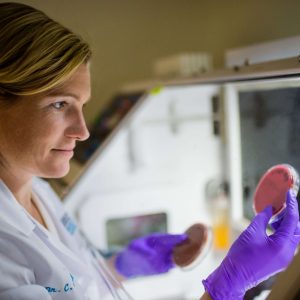
Caroline Mitchell, MD, MPH, a VCRB investigator, is studying how microbial changes in the vagina and urinary tract lead to health complications across the lifecycle of women. The human vagina is normally dominated by one bacterial species — Lactobacillus. When that population is disrupted by the emergence of other types of bacteria, it causes bacterial vaginosis. Symptoms range from the unpleasant including vaginal itching, odor or discharge, to the far more serious including increased risk of contracting sexually transmitted infections, difficulty conceiving, and higher risk of premature delivery and low birth-weight. Her research has shown these more serious complications are caused by inflammation, for which she is seeking treatments. To that end, Dr. Mitchell is working to develop an in vitro model of vaginal tissue to allow pre-clinical testing of new therapies. In collaboration with colleagues at the Ragon Institute, she used an early version of this model to help confirm the inflammatory potential of certain vaginal bacteria associated with a higher risk of acquiring HIV. Among recent clinical studies, she compared three options to relieve postmenopausal vaginal discomfort — a low-dose estrogen vaginal tablet, a nonprescription moisturizer, and a placebo gel — and found similar improvements for all three groups, pointing to the need to understand the underlying biology of what causes symptoms. Her lab is currently analyzing biologic samples from that study to help explain the results. At the other end of the lifespan, she is working with investigators at the Broad Institute to better understand how the vaginal microbiota of pregnant women influence the infant gastrointestinal microbiome, as prior studies have shown that being born vaginally leads to a different gastrointestinal bacterial community than being born via C-section.
Learn More
Publications
- Efficacy of vaginal estradiol or vaginal moisturizer vs. placebo for treating postmenopausal vulvovaginal symptoms: a randomized clinical trial.
- Lactobacillus-deficient cervicovaginal bacterial communities are associated with increased HIV acquisition in young South African women.
- Vaginal microbiota and genitourinary menopausal symptoms: a cross-sectional analysis.