
VINCENT DEPARTMENT OF OBSTETRICS AND GYNECOLOGY
Gynecologic Tissue Repository
The Gynecologic Tissue Repository at Mass General is an indispensable resource for scientists to learn how women’s cancers develop and devise new ways to improve prevention, diagnosis and treatment, including combatting drug-resistant cancers. This “biobank” is located in the Vincent Center for Reproductive Biology (VCRB), a funding priority of The Vincent Memorial Hospital Foundation (VMHF), which last year infused $685,000 into this nationally acclaimed OB/GYN laboratory, where researchers seek to identify innovative pathways to advance women’s health.

What Is a Biobank?
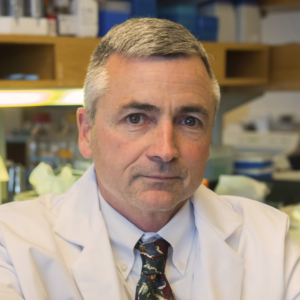
A biobank is more than a collection of frozen tissue and bodily fluids. It’s ultimately about gaining knowledge about what promotes early cancer development, what’s fueling the tumor growth and what factors trigger drug-resistant recurrent disease. It sets the stage for the development of new treatment strategies. Founded in 2005 by Bo Rueda, PhD (see photo in section below), director of the VCRB, the Gynecologic Tissue Repository at Mass General has accrued samples from more than 2,500 cancer patients, who have consented to having their tissues stored and organized in a systematic way for current and future research. The samples acquired are excess material from those recovered as part of a regularly scheduled gynecologic procedure. Adding exponential value to the samples is the compilation of clinical information maintained on a customized encrypted database, assisting researchers with the uniqueness of each patient’s tumor or blood sample. “Patient privacy is strictly protected with multiple layers of deidentification,” Dr. Rueda said. Only approved personnel have access. “Research findings derived from these samples are stripped of any specific patient identifiers and shared among our colleagues and collaborators,” he added. “The biobank becomes an ever-evolving multiplex storage depot that inspires scientific inquiry.” Portions of the samples are used to create models to better understand how tumors become resistant to specific treatment regimens and how to overcome resistance. Dr. Rueda and his team generate “xenografts,” in which the patient’s tumor cells are grafted into an animal model, and “organoids,” which are three-dimensional cultures derived from tumor cells, replicating much of the cellular complexity of the primary tumor. Scientists use these models to investigate cellular signals that drive cancers and how they develop resistance to specific drugs, then design new therapies to combat them.
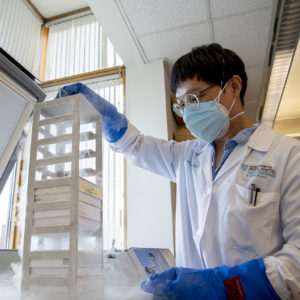
Photo: Mengyao Xu, PhD (left), a postdoctoral fellow in the laboratory of Oladapo Yeku, MD, PhD, FACP (right), who is pursuing new ways to treat ovarian cancer, accesses tissue samples from the subzero biobank (–319 degrees F.).
Integrated Powerhouse
Translational studies in the women’s cancers program are made possible by the collective efforts of basic and clinical scientists who are part of a gynecologic oncology research consortium called REsearch to Advance cancer Care and promote Hope (REACH). The consortium is a highly interactive network that draws from several departments at Mass General. It integrates knowledge, technology, resources and personnel focused on combatting gynecologic malignancies. In addition to Dr. Rueda (photo at left), the consortium is co-led by Eric Eisenhauer, MD, chief of the Division of Gynecologic Oncology in the Vincent Department of Obstetrics and Gynecology composed of eight surgeons. Also, Cesar Castro, MD, director of the Mass General Gynecologic Medical Oncology Group, a team of medical oncologists who treat gynecologic cancers with chemotherapy and new innovative drug trials. This highly collaborative model of research, education and care provides hope for cancer patients. “The support of the VMHF, grateful patients, philanthropic foundations and the individuals involved has been pivotal in the growth and success of the gynecologic tissue bank,” Dr. Rueda said. “It will serve as a valuable resource for decades to come.”
Latest Cancer Research
Since its launch nearly two decades ago, the VCRB biobank supports the research efforts of investigators within and outside the Department of OB/GYN. Below is a sampling:
• Bo Rueda, PhD, molecularly interrogates gynecologic tumors to identify signaling pathways that contribute to malignant transformation, the pathology of the disease, immune suppression, tumor recurrence and resistance to therapy.
• Cesar Castro, MD, harnesses nanotechnology and molecular imaging platforms for ovarian cancer detection, advancing novel technologies to generate integrated profiles of DNA, RNA and protein within scant specimens of ovarian cancer, down to the single-cell level. He also actively promotes sample collection from drug-resistant tumor cells for banking.
• Eric Eisenhauer, MD, continues to develop innovative surgical approaches for patients with advanced gynecologic cancers, promote advances in tumor imaging and early-phase drug trials, and actively promote tissue banking among his surgical colleagues.
• Cheng Wang, PhD, who studies the Hippo-Yap signaling pathway that regulates the normal physiology of the cervix and ovary, has shown increased Yap signaling can allow cancers to evade the immune system, and he is developing treatment strategies to overcome this immunotolerance.
• David Spriggs, MD, who focuses on cell membrane glycoproteins that promote ovarian cancer, has revealed the glycoprotein MUC16 regulates growth, invasion and metastatic disease, and he is developing antibodies against MUC16 and other components involved.
• Oladapo Yeku, MD, PhD, FACP, designs and tests immunologic approaches to manage ovarian cancer, including new ways to recruit and harness patients’ own immune cells against cancer.
• Sara Bouberhan, MD, works to identify blood-based biomarkers in ovarian cancer, using blood collected through the tissue banking protocol at the time of patients’ initial gynecologic surgery to identify circulating tumor DNA. which could help with implementing their next treatment regimen.
• Steven Skates, PhD, who studies early detection of ovarian cancer including biomarker discovery and validation, has developed multiple algorithms now being studied in early -detection clinical trials.
• Amy Bregar, MD, who focuses on early detection of ovarian cancer, is developing biomarkers for triaging patients for more personalized clinical care.
Guided by faculty mentors, the tissue repository serves as vital resource for residents receiving OB/GYN specialty training at Mass General as well as Vincent fellows and postdoctoral fellows in the subspecialty of gynecologic oncology, who have access to this large collection of samples to address clinically applicable research questions and find novel solutions.
Photo: Peichao Chen, PhD, a postdoctoral fellow in the lab of Cheng Wang, PhD, is studying microbial infections that promote high-grade serous ovarian cancer, aiming to prevent this deadly disease or stop its progression in early stages.