
VINCENT FELLOWS IN UROGYNECOLOGY AND RECONSTRUCTIVE PELVIC SURGERY
Advancing Urinary and Vaginal Health
To help women return to a normal lifestyle. the Urogynecology and Reconstructive Pelvic Surgery (URPS) program provides Vincent OB/GYN patients comprehensive evaluations and treatment for female pelvic floor problems, including pelvic organ prolapse and urinary incontinence. In lab research, our Vincent fellows are seeking novel ways to prevent and treat urinary and vaginal infections.
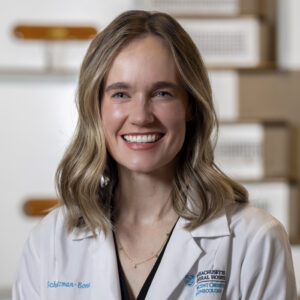
What is the Impact and Mechanism of Boric Acid in the Treatment of Bacterial Vaginosis?
Stephanie Schatzman-Bone, MD, a Vincent fellow in Urogynecology and Reconstructive Pelvic Surgery (URPS), is studying bacterial vaginosis (BV), one of the most common causes of vaginitis, accounting for up to 50% of cases in reproductive-aged women. BV is characterized by a shift in the normal Lactobacillus-dominant vaginal microbiome to other, primarily anaerobic, microbes such as Gardnerella vaginalis. Patients experience bothersome symptoms that impact their daily lives, including malodorous discharge, pain, dysuria and dyspareunia. BV also is associated with numerous morbidities such as preterm labor, postoperative infections and increased rates of sexually transmitted infections. BV has high recurrence risks — up to 33% at 3 months after treatment and up to 66% at 1 year — posing a frustrating clinical scenario to patients and physicians alike. Because of the high rate of failure with antibiotic treatment, intravaginal boric acid has long been used by clinicians to treat vaginitis such as recurrent BV. However, its mechanism and impact on the vaginal microbiome is poorly understood. The aim of this research project is to characterize the impact and mechanism of boric acid on both beneficial and pathogenic vaginal microbiota. Specifically, Dr. Schatzman-Bone is comparing the impact of boric acid exposure on the growth and viability of Lactobacillus crispatus and Gardnerella vaginalis. She also is seeking to further characterize the antibacterial mechanism of boric acid.
Faculty Mentor
Caroline Mitchell, MD, MPH, Investigator, Vincent Center for Reproductive Biology, Division of URPS, Associate Professor, Obstetrics, Gynecology and Reproductive Biology, Harvard Medical School
Career Path
MD: University of Oklahoma College of Medicine, 2016–2020
OB/GYN Residency: BWH/MGH Integrated OBGYN Residency, 2020–2024
Vincent Fellowship: 2024–2027
Publications
- Building a supportive clinical learning environment: orienting newly licensed nurses to their impact on the professional development of physician trainees
- Hypoxia as a therapy for mitochondrial disease
- Reasons for missed appointments
- Retrospective cohort study of mesh-related complications of minimally invasive sacrocervicopexy in 603 cases

What Healthcare System–based Barriers to Urogynecologic Care Are Faced by Underserved Patient Populations in Boston?
Alexis Griffin Bonhomme, MD, a Vincent fellow in Urogynecology and Reconstructive Pelvic Surgery (URPS), is examining the knowledge of and healthcare system–based barriers to urogynecologic care in underserved patient populations in the Boston area. In conjunction with Mass General physical therapists Lynn Gray-Meltzer, DPT, and Yasaman Zarbafian, DPT, she is hosting a series of 25 educational seminars around Boston about urogynecology, what treatment options are available for urinary and pelvic symptoms, and the MGH urogynecology clinic. Current literature identifies patient and provider-related barriers to urogynecologic care, such as embarrassment, knowledge and limitations in communication, but fails to acknowledge healthcare system–related barriers that are unique to those underrepresented in medicine (i.e., systemic racism). Individuals attending the educational seminars are eligible to participate in her mixed-methods research study, which employs both surveys and in-depth interviews to assess help-seeking behaviors in those who are underserved. Dr. Griffin Bonhomme will further assess the impact of the community-based seminars by retrospectively examining the racial and ethnic demographics of the patients seen in Mass General’s Urogynecology clinic before and after the seminar series.
Faculty Mentors
Caroline Mitchell, MD, MPH, Investigator, Vincent Center for Reproductive Biology, Division of URPS, Associate Professor, Obstetrics, Gynecology and Reproductive Biology, Harvard Medical School
Milena Weinstein, MD, Chief, Division of URPS
Emily Von Bargen, DO, URPS Fellowship Program Director
Kristin Hung, MD, URPS Faculty
Marcus Ortega, MD, URPS Faculty
Youngwu Kim, MD, URPS Faculty
Career Path
MD: University of South Alabama College of Medicine, 2015–2019
OB/GYN Residency: Tufts Medical Center, 2019–2023
Vincent Fellowship: 2023–2026
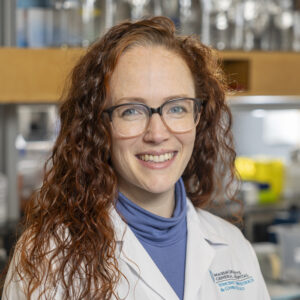
Are Vaginal Lactobacillus Species and Cytokine Activity in Postmenopausal Women Associated with Overactive Bladder Symptoms?
Elizabeth Hoover Dotson, DO, a Vincent fellow in Urogynecology and Reconstructive Pelvic Surgery, is examining the association between vaginal Lactobacillus species, cytokine activity and overactive bladder symptoms among postmenopausal women. To date, research has shown that loss of estrogen in the postmenopausal period is associated with a shift in the healthy Lactobacillus-dominated vaginal microbiota to a more diverse bacterial community. Moreover, the bacterial communities of the bladder and vagina are closely related, and microbiota that are low in Lactobacillus have been associated with reduced efficacy of overactive bladder treatment. The underlying pathophysiology of overactive bladder syndrome is not completely understood, including the role of cytokines — chemical messengers of the immune system involved in inflammation. In a secondary analysis of a prior 302-patient study spearheaded by Dr. Caroline Mitchell’s lab in 2018, she will further elucidate the impact of the vaginal microbiome and inflammation as a cause of overactive bladder symptoms, potentially leading to new treatment strategies.
Faculty Mentors
Caroline Mitchell, MD, MPH, Investigator, Vincent Center for Reproductive Biology, Division of URPS, Associate Professor, Obstetrics, Gynecology and Reproductive Biology, Harvard Medical School
Milena Weinstein, MD, Chief, Division of URPS
Emily Von Bargen, DO, URPS Fellowship Program Director
Kristin Hung, MD, URPS Faculty
Marcus Ortega, MD, URPS Faculty
Career Path
DO: West Virginia School of Osteopathic Medicine, 2014–2018
OB/GYN Residency: University of Virginia, 2018–2022
Vincent Fellowship: 2022–2025